
The Worldless Market and the Political Act
The Parallax ViewThis thread traces the challenge of political action in a capitalist order that continually dissolves its own boundaries.
increasing Bearing strength in each event
 decreasing
Bearing strength in each eventdecreasingCapitalism Without a Cultural World

Universality Without Shared Meaning
A neutral economic matrix
Capitalism adapts to many religious and cultural worlds. It does not need one coherent civilizational identity to expand.
A distinctive danger
Its universality is difficult to oppose because it appears as ordinary economic reality rather than a particular political doctrine.
The State Is Not the Whole Enemy

Beyond a Single Target
Political and economic levels diverge
A struggle against state domination does not automatically challenge the capitalist form. Economic processes cannot be reduced to politics, but politics cannot ignore them.
The trap of abstraction
A politics that treats economic relations as merely one issue among others risks leaving their structuring force intact.
The Multitude’s Promise

Cooperation as Common Production
New forms of labor
Immaterial labor produces communication, cooperation, and social relations alongside goods. Hardt and Negri see this shared production as a basis for a new democracy.
A question of form
The book asks whether capitalist organization already contains the future order or whether the capitalist form remains a necessary obstacle.
The Revolution’s Missing Structure

Beyond the Failed Leap
A rupture is not a program
The Cultural Revolution reveals the limits of trying to escape party-state power through a sudden break. Its failure cannot be made into a ready-made political model.
The economic question returns
The book argues that emancipatory politics must restore the economy as a possible site of truth and change, not leave it outside the struggle.
The Slum as an Evental Site
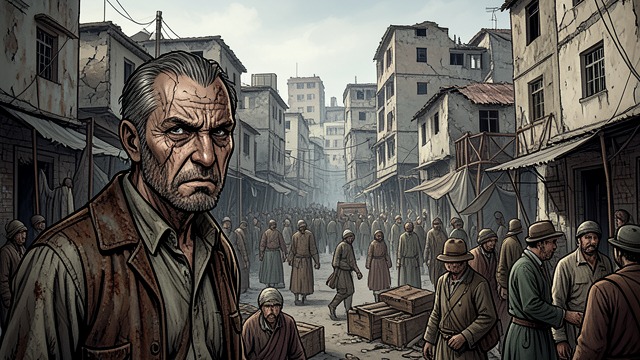
A New Proletarian Question
Dispossession at the urban edge
Slum dwellers are excluded from secure citizenship yet remain connected to global capitalism. Their condition is a product of the system, not an external accident.
Possibility without idealization
The book considers slums potential evental sites while warning against romanticizing their inhabitants. New forms of collective life remain uncertain.
Chapter 5, discussion of global capitalism
Chapter 5, discussion of emancipatory politics
Chapter 5, discussion of Hardt and Negri
Chapter 5, after the discussion of the Cultural Revolution
Chapter 5, closing discussion
